Customer Identity
Customer Identity and Access Management (CIAM) governs the full lifecycle of external, self-service user identities — from the moment a stranger signs up to the moment their account and data are permanently removed. It differs from workforce identity in almost every threat assumption: registrants are anonymous until proven otherwise, there is no HR process vouching for who they are, the population is orders of magnitude larger, there is no help desk relationship to fall back on, and privacy regulation (GDPR, CCPA, and equivalents) directly governs what can be collected, how long it can be kept, and how it must be erased. This article covers the lifecycle end to end: registration, verification, ongoing authentication, profile and consent management, account recovery, and de-registration.
For concrete guidance on the credentials themselves, this article defers to and cross-references the existing Passwords and Multi-Factor Authentication articles rather than repeating them — this article covers what happens around the credential across the account's lifetime.
The Lifecycle
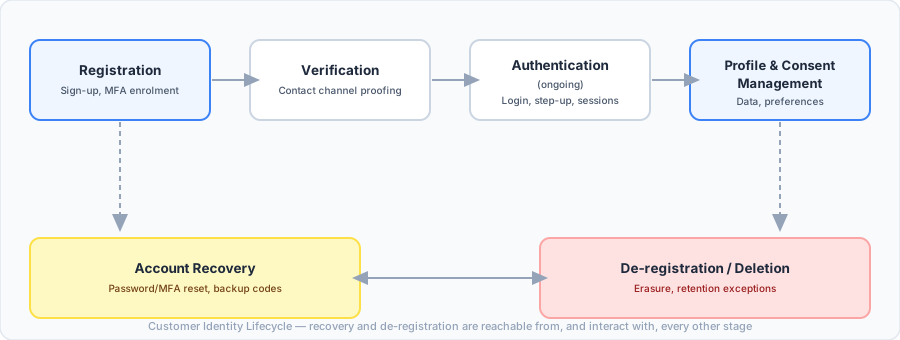
Each stage is covered below, followed by the threats specific to a customer-facing (as opposed to workforce) identity population.
1. Registration
Registration is the highest-risk moment in the lifecycle from a fraud perspective (anyone on the internet can attempt it) and the highest-leverage moment from a security posture perspective (decisions made here — password strength, MFA enrolment, verified contact channel — determine the account's baseline security for its entire life).
Credential Collection
Apply the full guidance in Passwords at the point of registration — minimum length, banned/breached password checks, Argon2id/bcrypt storage, no forced complexity rules. Do not weaken these requirements "to reduce sign-up friction"; a weak password accepted at registration is a weak password for the life of the account, since mandatory rotation is not the current NIST recommendation.
Prefer a passwordless registration path where the product supports it — passkey/FIDO2 registration at sign-up avoids creating a password at all. Where a password is collected, treat MFA enrolment as part of the same flow rather than a later, optional step (see below).
MFA Enrolment at Sign-Up
Prompt for MFA enrolment during registration, not as a post-signup nag screen most users dismiss. Use the ranked guidance in Multi-Factor Authentication to decide which factor to offer by default:
- Offer passkeys/FIDO2 as the primary option where the platform supports it (most modern mobile OSes and browsers do).
- Fall back to authenticator app with number matching as the realistic baseline where hardware-backed options aren't available.
- Avoid defaulting to SMS OTP as the only offered factor — per the MFA article, it is the weakest widely-deployed option and should be a fallback, not the default.
- Require at least two registered recovery paths (e.g. a registered MFA factor plus backup codes) before the account is considered fully enrolled — a single point of failure at enrolment becomes a support burden and a security gap later.
Contact Channel Verification
Verify the registrant controls the email address or phone number provided before granting full access. This is one of the accepted exceptions to the general prohibition on email-delivered authentication links described in Magic Links — enrolment/verification is explicitly called out there as a legitimate use case, since the entire purpose of the flow is proving control of the channel. Apply the hardening controls from that article regardless: single-use, short-lived, hashed-at-rest tokens, an interstitial confirmation step to defeat email-scanner pre-fetch, and rate limiting on link issuance.
Bot and Fraud Prevention
Registration endpoints are a primary target for fake-account creation, promo/referral abuse, and building an inventory of accounts for later credential-stuffing or fraud campaigns. Apply the WAF guidance from Web Application Firewall and Advanced Web Application Firewall specifically to /register:
| Control | Purpose |
|---|---|
| CAPTCHA / frictionless challenge (see HTTP User Agents for Challenge vs Block guidance) | Raise the cost of scripted mass account creation |
| Disposable/temporary email domain detection | Blocks the most common fake-account pattern |
| Velocity limiting per IP / device fingerprint | Caps the rate of accounts a single source can create |
| Duplicate/similar-identity detection | Flags likely sockpuppet or fraud-ring registrations for review, not automatic rejection |
| Phone number reputation/VOIP detection | Reduces SMS-verification abuse and toll fraud |
Data Minimisation and Progressive Profiling
Collect only what is required to create the account and satisfy the immediate verification step. Defer optional profile data (marketing preferences, demographic details, address) to a later, explicitly optional step. This reduces the impact of a breach of the registration database, reduces regulatory exposure under data-minimisation principles (GDPR Art. 5(1)(c)), and reduces sign-up abandonment.
Consent Capture
Where registration triggers any data processing beyond strict account creation (marketing communications, analytics, third-party sharing), capture consent as a distinct, unbundled action — not a pre-ticked box or a condition of completing sign-up. Record what was consented to, the policy version presented, and the timestamp; this record is itself evidence required to demonstrate compliance later.
2. Identity Verification (Proofing)
Not all customer identities need the same assurance level. NIST SP 800-63A defines three Identity Assurance Levels (IAL) that scale proofing rigor to the risk of a false claim:
| Level | Requirement | Typical Use |
|---|---|---|
| IAL1 | No requirement to link the account to a real-world identity; self-asserted attributes only | Most consumer accounts — content, community, e-commerce browsing |
| IAL2 | Evidence supporting real-world existence of the identity, verified remotely or in person | Financial services, healthcare, anything handling regulated PII or payment instruments |
| IAL3 | In-person or supervised-remote proofing with an authorised representative verifying attributes directly | High-value government, financial, or legal use cases |
Most customer registration flows should target IAL1 with a verified contact channel — do not impose IAL2/IAL3 proofing (government ID upload, in-person verification) on a use case that doesn't require it; this adds friction, cost, and its own data-handling risk (storing scanned ID documents) without a corresponding risk reduction. Reserve stronger proofing for the specific actions that need it (e.g. verifying identity before releasing funds), applied as step-up verification at that point rather than a universal registration gate.
3. Authentication (Ongoing)
Day-to-day login is governed by Passwords and Multi-Factor Authentication — apply that guidance directly rather than a customer-specific variant of it. Two considerations specific to customer populations:
- Risk-based / adaptive authentication. Since customer accounts are accessed from a huge diversity of legitimate devices and locations (unlike a managed workforce fleet), a rigid "always challenge" or "never challenge" policy either frustrates legitimate users or misses risk. Score sign-ins on signals such as new device, impossible travel, and IP reputation, and step up to MFA (or an additional factor if none is registered) only when the score is elevated — see the ATO detection guidance in Advanced Web Application Firewall.
- Step-up authentication for sensitive actions. A session authenticated at login should not be sufficient, on its own, to change the registered email/phone, disable MFA, add a payment method, or initiate account deletion. Require re-authentication or a fresh MFA challenge immediately before these actions.
4. Session Management
- Issue session tokens with ≥128 bits of entropy from a CSPRNG; regenerate the session identifier on privilege change (e.g. immediately after login) to prevent session fixation.
- Give customers visibility into their own active sessions/devices and a self-service "sign out of all other devices" action — this is both a security control and a common support-deflection feature (users who suspect compromise can act immediately without contacting support).
- Apply idle and absolute session timeouts appropriate to the sensitivity of the application (a banking app and a content site have very different acceptable exposure windows).
- Invalidate all sessions server-side on password change, MFA factor change, or detected account compromise — do not rely on client-side cookie expiry alone.
5. Profile and Consent Management
Customers need durable, self-service control over their own data — both because it is good practice and because it is a legal requirement in most jurisdictions the account may be subject to.
- Self-service data access and export. Provide a mechanism for the user to view and export their stored data (GDPR Art. 20 — data portability). This also reduces support load from manual data-access requests.
- Re-verification on contact-channel change. Changing the registered email or phone number is functionally equivalent to changing the account's recovery path — require the same step-up authentication as MFA changes, verify the new channel before it becomes active, and notify the old channel that a change occurred (see the second-channel notification pattern in Magic Links) so a legitimate owner can intervene if the change wasn't theirs.
- Consent preference centre. Let users view and withdraw consent for optional processing independently of deleting the account outright — withdrawing marketing consent should not require account deletion, and account deletion should not be the only way to exercise data rights.
6. Account Recovery
Recovery is where account-takeover risk concentrates, because by definition the user cannot authenticate through the normal path. Apply the password-reset guidance already established:
- Follow the Magic Links hardening controls for the reset link itself: single-use, short-lived, hashed token, interstitial confirmation, second-channel notification, and rate limiting on issuance.
- Do not confirm or deny whether a given email/phone is registered on the "forgot password" endpoint — a differing response for existing vs non-existent accounts is an account-enumeration vector that also aids credential-stuffing reconnaissance.
- Issue backup/recovery codes at MFA enrolment for the case where the user loses their primary factor, store them the same way as passwords (hashed, not plaintext), and treat their use as a high-risk event that triggers a notification.
- Route recovery requests for accounts with elevated risk indicators (recent MFA disablement, recent contact-channel change, active fraud flags) to manual review rather than fully automated reset — the same properties that make automated recovery convenient make it valuable to an attacker who has partially compromised an account.
7. De-registration
De-registration is the least-designed part of most CIAM systems, and the part most directly governed by regulation (GDPR Art. 17 "right to erasure", CCPA deletion rights, and equivalents elsewhere). It is not a single action — it is a sequenced process with legal, security, and operational constraints that pull in different directions.
User-Initiated Deletion
- Verify identity before executing the request. Account deletion is itself an attack — a hijacked session or a social-engineered support request can be used to destroy a legitimate user's account and data. Require re-authentication (password + MFA, not just an active session) immediately before processing a deletion request.
- Immediately revoke access, defer permanent purge. On request, invalidate all sessions, disable login, and revoke API tokens/OAuth grants tied to the account immediately. The underlying data can move into a time-boxed soft-delete / grace period (commonly 14–30 days) before permanent purge, disclosed clearly to the user, so an accidental or coerced deletion request can be reversed. The account must not be usable during this window even though the data has not yet been purged.
- Notify downstream processors. Where customer data was shared with third-party processors (analytics, email providers, support tooling), propagate the deletion request to them within the timeframe required by the applicable regulation and any data processing agreements in place.
- Purge from backups on a defined schedule. Immediate purge from backups is often technically impractical; document a maximum retention period after which backups containing the deleted record are themselves rotated out, and treat that period as part of the organisation's stated deletion SLA.
Data That Must Be Retained Despite a Deletion Request
Not everything can be deleted on request. Legal, tax, fraud-prevention, and security obligations frequently require retaining specific records past an erasure request — this is an accepted and lawful exception (e.g. GDPR Art. 17(3)), not a loophole, provided it is scoped and documented:
| Data Category | Reason for Retention | Typical Retention Period |
|---|---|---|
| Financial transaction records | Tax and accounting law | 6–7 years (jurisdiction-dependent) |
| Fraud investigation records tied to the account | Legitimate interest / legal obligation to combat fraud | Duration of investigation, then defined retention |
| Security/audit logs referencing the account (login events, admin actions) | Security monitoring and incident response | Aligned to the organisation's log retention policy |
| Records of the deletion request itself | Evidence of compliance with the erasure obligation | Duration required to demonstrate compliance |
When data is retained under one of these exceptions, minimise it to what the specific legal basis requires, isolate it from data used for any other purpose (it should not resurface in marketing, personalisation, or general analytics), and inform the user which categories are being retained and why.
Involuntary De-registration
- Fraud or Terms-of-Service violation. Suspend rather than immediately delete, preserving evidence needed for investigation, dispute handling, or law enforcement referral. Define a retention period for this evidence distinct from standard account data.
- Dormancy. Where a policy disables or deletes accounts after a period of inactivity, notify the user through their verified contact channel before acting, with a clear reactivation path within a defined threshold before the account is treated as eligible for deletion.
Deletion Audit Trail
Log that a deletion request was received, verified, and completed — including timestamps and the verification method used — as evidence of compliance. The audit log entry itself should not retain the deleted personal data beyond an identifier sufficient to prove the record existed and was actioned (e.g. a hashed account ID), to avoid the audit trail becoming a second copy of the data the user asked to have erased.
Customer Identity vs Workforce Identity
| Dimension | Workforce IAM | Customer IAM (CIAM) |
|---|---|---|
| Provisioning | HR-initiated, identity pre-vetted | Self-service, anonymous until verified |
| Scale | Hundreds to tens of thousands | Thousands to hundreds of millions |
| Recovery path | IT help desk can manually verify and assist | Must be fully self-service; no help desk relationship |
| Registration threat model | Low — attacker rarely controls provisioning | High — registration endpoint is a direct fraud/bot target |
| Privacy regulation exposure | Employment law, generally lower direct consumer-rights exposure | GDPR/CCPA-style consumer data rights apply directly and at scale |
| Deletion obligation | Offboarding process, internally driven | Legally mandated, user-initiated, time-bound |
| Session/device diversity | Managed fleet, relatively uniform | Fully heterogeneous — any device, anywhere |
Hardening Checklist
| Control | Priority | Notes |
|---|---|---|
| Password requirements at registration match Passwords guidance | Critical | No weakened rules "for onboarding ease" |
| MFA enrolment offered/required as part of registration, not a later optional step | High | Use ranked guidance in Multi-Factor Authentication |
| Contact channel (email/phone) verified before full account access granted | Critical | Apply Magic Links hardening to the verification link/OTP |
| Registration endpoint protected against bot/fraud (CAPTCHA, disposable email, velocity limits) | High | Registration is a direct fraud target, unlike workforce provisioning |
| Data collection at sign-up limited to what's required; optional data deferred | Medium | Data minimisation principle; reduces breach impact |
| Consent captured as a distinct, unbundled, timestamped action | High | Required evidence for compliance |
| Re-authentication required before changing contact channel, disabling MFA, or deleting account | Critical | Prevents session-hijack-driven account destruction or takeover |
| Old contact channel notified when contact details change | High | Surfaces attacker-initiated changes to the legitimate owner |
| Forgot-password endpoint does not reveal whether an account exists | High | Prevents account enumeration |
| Recovery/backup codes issued at MFA enrolment, stored hashed | Medium | Same handling as passwords |
| Account deletion request verified, then sessions/access revoked immediately | Critical | Immediate access revocation, even if data purge is deferred |
| Soft-delete/grace period disclosed to the user before permanent purge | High | Allows recovery from accidental/coerced deletion requests |
| Legally-required retained data scoped, isolated, and disclosed to the user | High | GDPR Art. 17(3)-style exceptions must be documented, not open-ended |
| Downstream processors notified of deletion requests within SLA | Medium | Required where data was shared with third parties |
| Deletion audit trail retains proof of action without retaining the erased data itself | Medium | Avoids the audit log becoming a second copy of deleted PII |
References
- Passwords
- Multi-Factor Authentication
- Magic Links
- Web Application Firewall
- Advanced Web Application Firewall
- NIST SP 800-63A — Enrollment and Identity Proofing
- NIST SP 800-63B — Digital Identity Guidelines: Authentication and Lifecycle Management
- OWASP Application Security Verification Standard (ASVS) — Authentication & Session Management
- GDPR Article 17 — Right to Erasure
- GDPR Article 20 — Right to Data Portability
- California Consumer Privacy Act (CCPA)